
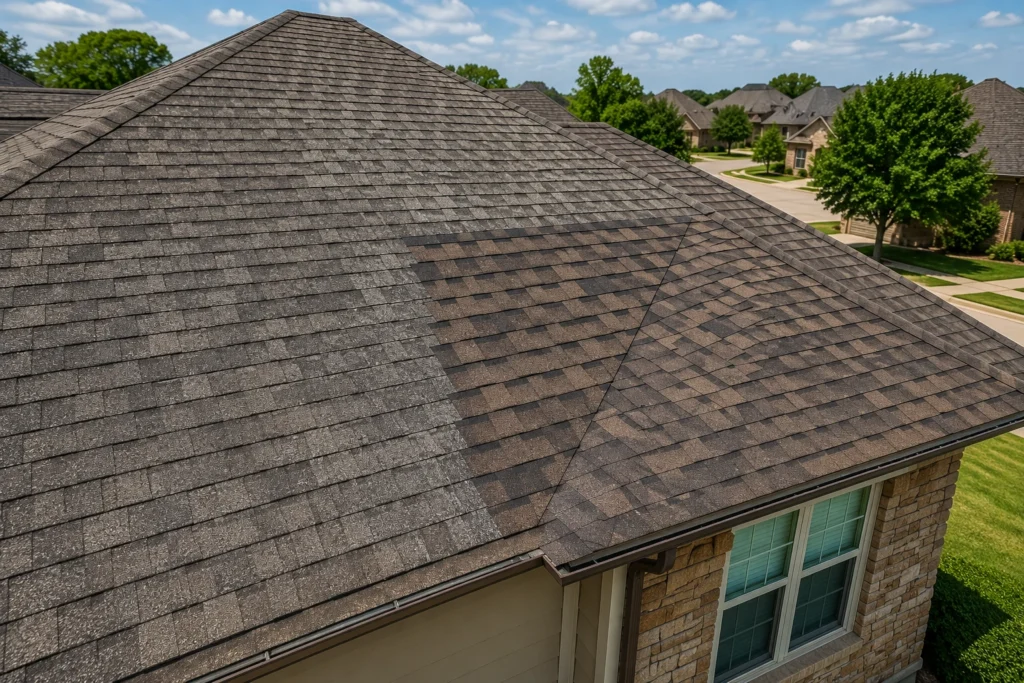
Storm damage can leave homeowners facing more than broken shingles and leaking ceilings. One of the most frustrating issues begins after the inspection, when questions arise about whether repaired sections will actually match the rest of the roof. Understanding matching laws for roof replacement in Desoto, TX is essential before accepting any insurance settlement because the outcome can affect your home’s appearance, value, and long-term protection. A repair that technically fixes the damage may still leave your roof looking noticeably different, creating concerns that continue long after the claim is closed. After a major hailstorm or wind event, many homeowners naturally assume that if part of the roof is damaged, the insurance company will simply replace the entire roofing system. In reality, claims are rarely that straightforward. Insurance companies evaluate policies carefully, roofing materials change over time, and matching existing shingles can become surprisingly complicated when products have faded or are no longer manufactured.
Those complications often lead to disagreements. One party may believe replacing a single slope is enough, while the homeowner believes a partial repair creates an obvious patchwork that diminishes the home’s overall appearance. Understanding why these disputes happen helps homeowners make more informed decisions before approving repairs. Although this article focuses on roof insurance claims, similar principles of documentation and policy interpretation also appear in other types of property losses. For example, Inside the Role of a Fire Insurance Adjuster explores how evidence and policy language influence claim outcomes, reinforcing the importance of understanding insurance obligations before accepting a settlement.
What Are Matching Laws in Roof Replacement?
The phrase “matching law” sounds simple, but it covers an issue that is anything but simple. When part of a roof suffers covered damage, homeowners generally want the repaired area to blend with the remaining roofing materials. Insurance companies, however, may focus on restoring function rather than appearance. That difference in perspective often becomes the center of the dispute.
A matching issue exists whenever replacement materials noticeably differ from the undamaged portions of the roof.
These differences may include:
- Color variations
- Different shingle profiles
- Texture differences
- Varying weather patterns
- Thickness inconsistencies
- Manufacturer design changes
Even if new shingles come from the same manufacturer, years of sunlight and weather exposure may have changed the appearance of the existing roof enough that an exact match is no longer possible.
Understanding “Matching”
Matching involves far more than installing shingles that are roughly the same color. A proper evaluation considers whether the repaired section restores the home’s appearance to its condition before the loss occurred. Roofing materials naturally age. Granules fade. Colors soften. Surface textures change after years of exposure to ultraviolet light, rain, temperature swings, and airborne contaminants.
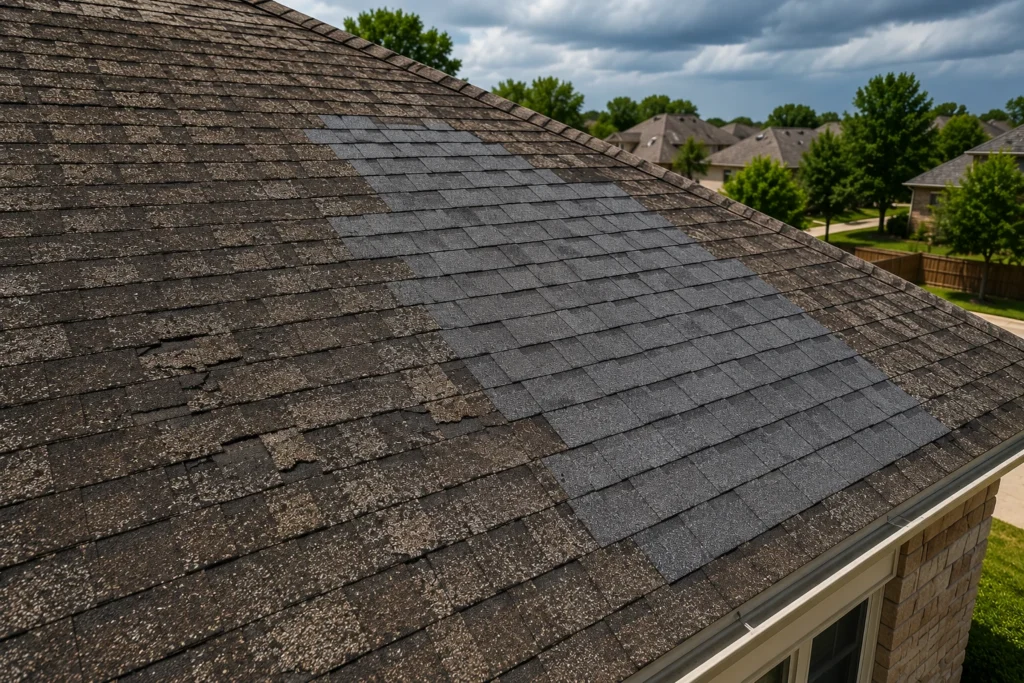
Installing brand-new materials next to weathered shingles may produce a highly visible transition. While the roof may still function properly, the visual difference can be difficult to ignore. This distinction explains why matching disputes frequently arise even when everyone agrees the damaged area itself requires replacement.
Why Matching Matters
Some people assume matching is merely an aesthetic concern. That isn’t always true. An inconsistent roof can influence several aspects of homeownership beyond appearance.
Potential impacts include:
- Reduced curb appeal
- Lower buyer confidence
- Appraisal concerns
- Neighborhood consistency
- Homeowners association expectations
- Questions during future inspections
A roof is one of the home’s largest visual features. Obvious inconsistencies may attract attention immediately, especially on neighborhoods where rooflines are highly visible from the street.
Does Texas Have a Roof Matching Law?
This question comes up in nearly every major roof claim. The answer surprises many homeowners. Texas does not have a specific statewide statute requiring insurance companies to replace an entire roof solely because replacement shingles do not perfectly match existing materials.
That does not automatically mean matching issues are irrelevant. Instead, much depends on the language contained within the insurance policy itself. Policies differ considerably. Some provide broader replacement obligations, while others contain endorsements that specifically limit cosmetic damage claims or narrow replacement responsibilities. Because of those differences, two neighboring homeowners with identical storm damage may receive different claim outcomes simply because their policies contain different wording.
The Importance of “Like Kind and Quality”
One phrase appears frequently throughout property insurance policies:
Like kind and quality.
Although the wording sounds straightforward, interpretation can become complicated when roofing materials have changed significantly since the roof was originally installed.
Questions often include:
- Is the replacement material reasonably similar?
- Does the new product perform similarly?
- Is appearance part of the comparison?
- Can discontinued products satisfy the requirement?
- Does the repaired section restore the roof to its pre-loss condition?
These questions rarely have universal answers. Instead, each claim depends upon available materials, policy language, inspection findings, and supporting documentation.
Replacement Cost Versus Actual Cash Value
Coverage type also plays a significant role. Replacement Cost Value (RCV) generally provides broader reimbursement than Actual Cash Value (ACV), although each policy contains its own limitations and conditions. Understanding the difference early in the claims process helps homeowners set realistic expectations regarding settlement calculations.
| Coverage Type | General Purpose |
| Replacement Cost Value | Pays based on replacement cost, subject to policy terms |
| Actual Cash Value | Considers depreciation before payment |
| Cosmetic Damage Exclusion | May limit coverage for appearance-related issues |
| Matching Endorsement | May provide additional matching protections depending on policy language |
Common Roof Matching Problems After Storm Damage
Every roof ages differently. Even homes built at the same time within the same subdivision may weather differently depending on sunlight exposure, tree coverage, roof orientation, ventilation, and maintenance history. Those differences become especially noticeable when repairs involve only one section of the roof.
Discontinued Shingles
Manufacturers periodically discontinue product lines. This is one of the most common reasons matching disputes occur. Even if homeowners know the original manufacturer and color name, identical shingles may simply no longer exist. Without an available replacement, contractors must search for the closest comparable material rather than an exact match.
Weathered Roofing Materials
Nature changes every roof. Years of sunlight gradually bleach pigments. Rain removes surface granules. Seasonal temperature changes alter the appearance of roofing materials over time. Brand-new shingles installed beside a roof that’s ten or fifteen years old often stand out immediately. The contrast can remain visible for years.
Color Fading
Color variation may seem minor while viewing a single shingle. Across an entire roof slope, however, the difference becomes much more obvious.
Factors affecting color include:
- Sun exposure
- Tree shading
- Roof orientation
- Manufacturing batch
- Granule aging
- Moisture exposure
Even slight differences become amplified when hundreds of shingles are viewed together.
Manufacturer Design Changes
Manufacturers continually update products.
Changes may include:
- New adhesive technology
- Different granule blends
- Modified dimensions
- Revised textures
- Updated performance ratings
These improvements benefit future installations but may complicate repairs involving older roofing systems.
Different Production Batches
Even products carrying identical color names may differ slightly between production runs. Manufacturers generally acknowledge acceptable color tolerances during production. Most homeowners never notice those differences until only part of the roof requires replacement.
When Can an Insurance Company Approve a Full Roof Replacement?
Not every damaged roof qualifies for complete replacement. Likewise, not every partial repair adequately restores the property. Insurance companies evaluate several factors before determining the appropriate scope of repairs.
Material Is No Longer Manufactured
One important consideration involves availability. If replacement shingles have been discontinued, finding a compatible product becomes significantly more difficult. Documentation from manufacturers confirming discontinued products often becomes valuable evidence during claim discussions.
No Comparable Match Exists
Sometimes substitute products exist. Unfortunately, they may differ enough that the repaired section remains visibly inconsistent with the rest of the roof.
Contractors frequently compare:
- Color
- Texture
- Profile
- Thickness
- Exposure dimensions
- Granule composition
When meaningful differences remain despite reasonable efforts, broader replacement discussions may occur.
Matching Creates an Obvious Patchwork Appearance
Imagine replacing only twenty shingles on a weathered roof. Technically, the damage has been repaired. Visually? The result may resemble a checkerboard. Large patchwork repairs often attract attention immediately from the street. Although appearance alone doesn’t automatically require complete replacement, substantial visual inconsistency frequently becomes part of broader claim discussions involving restoration quality.
Repair Cannot Restore Pre-Loss Condition
Insurance generally seeks to restore covered property as closely as practical to its condition before the loss. When partial repairs cannot reasonably achieve that objective because suitable materials no longer exist, homeowners often present additional documentation supporting expanded repairs.
Evidence may include:
- Manufacturer letters
- Roofing contractor evaluations
- Product availability reports
- Material comparison photographs
- Laboratory identification reports
- Independent inspection findings
The stronger the documentation, the clearer the discussion becomes.
How Insurance Companies Evaluate Roof Matching Claims
Every claim begins with information. The insurance company gathers documentation, reviews the policy, inspects the damage, and evaluates available repair options before determining whether a partial repair or broader replacement is appropriate. Understanding that evaluation process helps homeowners prepare more effectively.
Inspection Process
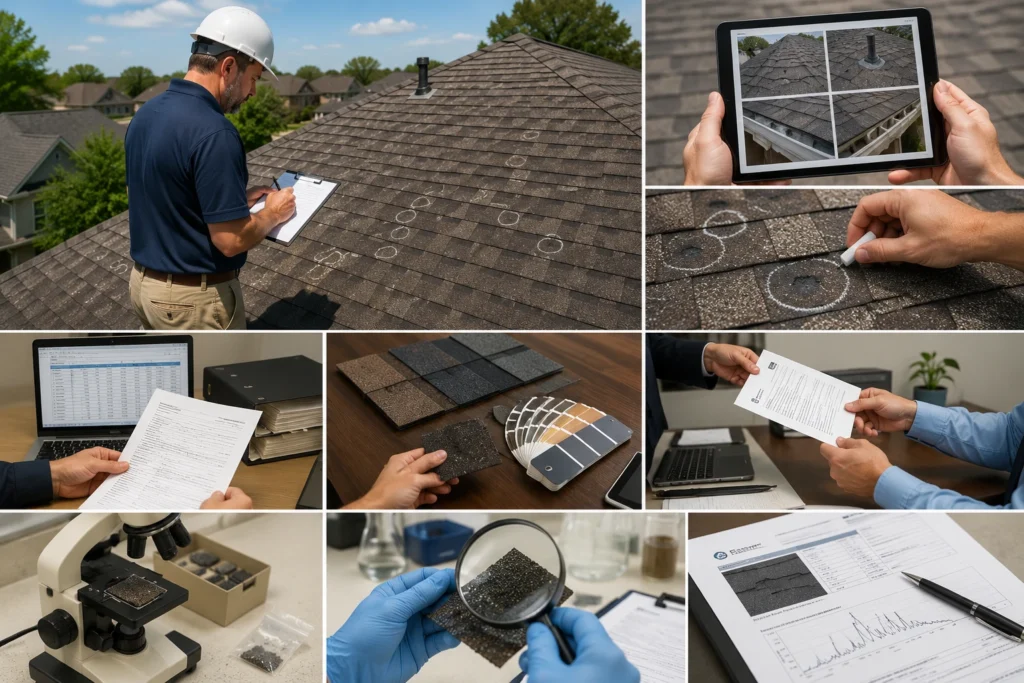
Adjusters begin by examining both the damaged and undamaged portions of the roof.
Their inspection may include:
- Storm-related impacts
- Age of roofing materials
- Overall roof condition
- Signs of previous repairs
- Installation quality
- Maintenance history
- Visible deterioration
The objective is to separate covered damage from ordinary aging or unrelated conditions.
Damage Documentation
Photographs play an important role throughout the claim.
Comprehensive documentation often includes:
- Overall roof views
- Close-up damage photographs
- Shingle condition
- Ridge caps
- Flashing
- Gutters
- Roof penetrations
- Interior water damage if applicable
Detailed records create a stronger foundation for evaluating both damage and matching concerns.
Material Availability
Availability research frequently follows the inspection.
Insurance representatives, contractors, or roofing suppliers may attempt to locate:
- Original manufacturer
- Product line
- Color designation
- Comparable replacements
- Current inventory
- Discontinued notices
Simply assuming materials are unavailable is rarely sufficient. Verification strengthens the discussion considerably.
Manufacturer Verification
When uncertainty exists, manufacturers themselves may provide valuable clarification. Letters confirming discontinued products or identifying the closest available alternatives can help explain whether an exact match remains possible. These documents often become part of the overall claim file.
Independent Material Testing
In some situations, roofing samples are sent to specialized laboratories for identification. One widely recognized service is ITEL, which analyzes roofing materials to determine the manufacturer, product line, and potential replacement options.
Laboratory identification can reduce uncertainty and provide objective information when multiple parties disagree about the original roofing product.
Important Policy Language That Can Affect Your Claim
Insurance policies are contracts. Every word matters. Many homeowners focus almost entirely on the adjuster’s estimate, yet the policy itself often carries more weight than the estimate during a coverage dispute. Taking the time to understand a few key provisions before agreeing to repairs can prevent costly surprises later.
If I could offer one practical tip, it would be this: read the settlement section of your policy before signing anything. It may answer questions that never come up during the inspection. The following provisions commonly influence roof matching decisions.
| Policy Provision | Why It Matters |
| Like Kind and Quality | Defines the insurer’s obligation to replace damaged materials with reasonably comparable products. |
| Loss Settlement | Explains how payments are calculated and when additional funds may be released. |
| Replacement Cost Coverage | Generally provides broader reimbursement than depreciation-based coverage, subject to policy conditions. |
| Cosmetic Damage Exclusion | May limit payment when damage affects appearance but not function. |
| Endorsements | Can expand or restrict coverage depending on the specific language added to the policy. |
A single endorsement can change the outcome of an otherwise identical claim. That is why relying on general advice from neighbors or online forums is risky. Your policy not someone else’s controls your claim.
Understanding Endorsements
Many homeowners never realize their policy has been modified after it was first issued. An endorsement is simply an amendment that changes the original contract. It may broaden protection, reduce coverage, or clarify how certain losses are handled.
Examples include:
- Cosmetic damage limitations
- Roof payment schedules
- Wind or hail deductibles
- Replacement cost endorsements
- Actual cash value endorsements
- Special roof exclusions
Reviewing these documents carefully provides a clearer picture of what benefits may actually apply after storm damage.
Steps Homeowners Should Take Before Accepting a Partial Roof Repair
Receiving an insurance estimate can feel like the finish line. In reality, it is often just the beginning. Before approving a contractor or accepting payment, homeowners should make sure the proposed repair genuinely restores the property as intended under the policy. A few extra days spent gathering information can prevent years of frustration.
Request Complete Documentation
Start by requesting copies of everything related to the claim.
Important documents may include:
- Inspection reports
- Photographs
- Adjuster’s estimate
- Coverage letter
- Material specifications
- Engineering reports, if applicable
- Correspondence regarding the claim
Keeping organized records also makes future discussions much easier if questions arise.
Verify Material Availability
Never assume replacement materials are available simply because someone says they are. Ask for documentation showing:
- Manufacturer name
- Product line
- Color
- Availability status
- Supplier confirmation
If the original shingles have been discontinued, written confirmation can become valuable evidence.
Compare Samples Side by Side
Seeing two shingles on a computer screen tells only part of the story. Whenever possible, compare actual samples outdoors under natural daylight.
Look closely at:
- Color
- Thickness
- Surface texture
- Granule appearance
- Overall profile
Small differences may become much more noticeable once installed across an entire roof.
Obtain an Independent Roofing Opinion
A qualified roofing contractor may identify concerns that were not fully addressed during the initial inspection.
Independent evaluations sometimes include:
- Additional storm damage
- Ventilation issues
- Hidden impacts
- Matching concerns
- Repair feasibility
Obtaining another opinion does not guarantee a different outcome, but it provides additional information for making informed decisions.
Review Your Policy Before Signing
One of the biggest mistakes homeowners make is assuming the estimate reflects everything the policy provides. Instead, compare the proposed repair with the policy language itself.
Questions worth asking include:
- Does the estimate restore the property?
- Are matching issues addressed?
- Were endorsements considered?
- Does the payment calculation follow the policy?
The answers may reveal issues that deserve further clarification.
How a Public Adjuster Can Help With Roof Matching Disputes
Roof matching disputes often involve more than selecting replacement shingles. They may require reviewing policy language, gathering evidence, documenting damage, and communicating with multiple parties throughout the claims process.
A public adjuster works on behalf of the policyholder rather than the insurance company. While every claim is unique, their involvement often focuses on presenting well-supported documentation that helps explain the homeowner’s position.
Independent Damage Assessment
An independent inspection provides another opportunity to evaluate the full extent of the damage.
This assessment may include:
- Roofing materials
- Flashing
- Ridge caps
- Gutters
- Skylights
- Vent penetrations
- Interior water intrusion
- Related structural concerns
A comprehensive inspection creates a stronger factual foundation for claim discussions.
Policy Interpretation
Insurance policies can be surprisingly detailed. A public adjuster reviews provisions that may affect the claim, including:
- Settlement language
- Definitions
- Exclusions
- Conditions
- Endorsements
- Deductibles
Understanding how these sections work together often helps clarify why disagreements occur.
Evidence Collection
Successful claims depend on evidence rather than assumptions. Supporting documentation may include:
- High-resolution photographs
- Contractor reports
- Material availability documentation
- Manufacturer correspondence
- Laboratory identification reports
- Repair estimates
Well-organized evidence helps present a clearer picture of the claimed loss.
Negotiating With the Insurance Company
Communication continues throughout the claim. Rather than relying solely on verbal discussions, negotiations often involve written documentation explaining why additional repairs or broader replacement may be appropriate under the policy. Clear communication supported by evidence generally produces more productive conversations.
Preparing Supplemental Claims
Sometimes additional damage becomes apparent only after repairs begin. Supplemental claims allow homeowners to present newly discovered covered damage along with supporting documentation.
Common examples include:
- Hidden decking damage
- Additional flashing problems
- Water intrusion
- Structural deterioration uncovered during repairs
Submitting supplements promptly helps keep the claim moving efficiently.
Mistakes Homeowners Make During Roof Matching Claims
Even strong claims can become more difficult when avoidable mistakes occur. Fortunately, many of these problems are entirely preventable. Here are some of the most common issues.
Assuming the First Decision Is Final
Insurance claims frequently involve additional reviews. If new evidence becomes available, homeowners may have opportunities to request reconsideration, depending on the policy and claim circumstances.
Throwing Away Damaged Materials
Damaged shingles may serve as valuable evidence later. Whenever practical and safe, ask the contractor whether representative samples should be retained until claim questions have been resolved.
Beginning Repairs Too Soon
Emergency mitigation is often necessary to prevent additional damage. Permanent repairs, however, should generally wait until adequate documentation has been completed whenever possible. Once materials are removed, proving the original condition becomes much more difficult.
Ignoring Policy Exclusions
Every policy contains limitations. Reading only the declarations page rarely provides enough information to understand the full scope of coverage. Instead, review the complete policy carefully.
Missing Deadlines
Insurance policies often include reporting requirements and time limits. Missing a deadline may complicate the claim unnecessarily.
Maintain a calendar tracking:
- Inspection dates
- Document requests
- Deadlines
- Contractor visits
- Follow-up communications
Organization saves time.
Depending on Memory
Storm claims generate a surprising amount of paperwork.
Rather than relying on memory, maintain a dedicated file containing:
- Emails
- Letters
- Estimates
- Invoices
- Photographs
- Notes from phone conversations
Good documentation often becomes one of a homeowner’s greatest assets. The science behind weathering and material degradation is surprisingly complex. Roofing products are continually exposed to environmental forces that gradually alter their physical and visual characteristics, making exact replacement more challenging over time. Understanding this natural process helps explain why two shingles manufactured years apart may no longer appear identical even when they originated from the same product line.
Building a Stronger Roof Claim From the Start
Many claim disputes are easier to prevent than to resolve. The strongest claims typically begin with careful preparation immediately after the storm. Consider creating a simple checklist before contacting your insurance company.
Include items such as:
- Photograph every roof slope.
- Capture gutters, flashing, vents, and skylights.
- Record the date and approximate time of the storm.
- Save inspection reports.
- Keep receipts for emergency mitigation.
- Document every conversation related to the claim.
- Request written responses whenever possible.
- Store digital copies in more than one location.
These habits take very little effort, yet they can make a meaningful difference if questions arise months later. Another practical step is to walk around your property after severe weather and document anything unusual. Dented gutters, damaged fencing, cracked skylights, or broken window screens may support the timeline of the loss and provide useful context during the investigation.
Consistency also matters. If multiple professionals inspect the roof, ask each one to explain their findings in writing. Comparing reports side by side often highlights areas where opinions differ, allowing you to ask more informed questions before repairs begin.
Final Thoughts
Roof matching disputes are rarely as simple as replacing a few damaged shingles. They involve policy language, available materials, inspection findings, manufacturer information, and careful documentation. While Texas does not have a blanket statute requiring every roof to be replaced for appearance alone, that does not mean homeowners should automatically accept a repair that leaves the roof visibly inconsistent. Understanding matching laws for roof replacement in Desoto, TX begins with understanding your own insurance policy. Reviewing the contract, verifying material availability, documenting the damage thoroughly, and asking thoughtful questions before approving repairs can help you make informed decisions throughout the claims process.
If your roof has suffered storm damage, take the time to gather facts before reaching conclusions. Compare materials carefully, preserve documentation, and ensure every recommendation is supported by evidence rather than assumptions. A little preparation today may help avoid unnecessary disputes tomorrow. For homeowners researching matching laws for roof replacement in Desoto, TX, knowledge remains one of the most valuable tools available. The more you understand about your policy, your roofing materials, and the claims process, the better equipped you’ll be to protect both your home and your investment.
FAQs
No. Texas does not have a statewide matching law requiring full roof replacement, so coverage depends largely on your insurance policy and the specific facts of the claim.
It generally means replacement materials should be reasonably comparable in quality and function to the damaged materials, subject to the policy’s terms.
If your shingles are no longer manufactured, your insurer may evaluate comparable alternatives, and documentation of the discontinued product can support discussions about broader replacement.
Yes. Significant fading can make new shingles stand out, which may become part of the overall evaluation when determining whether a reasonable match is possible.
It depends on the policy, the extent of the damage, and whether matching materials are available. Each claim is evaluated individually.
You can request documentation from manufacturers, roofing suppliers, or independent material identification services confirming that the original shingles have been discontinued or cannot be matched.
Emergency repairs to prevent further damage are often appropriate, but permanent repairs should generally wait until the claim has been properly documented and reviewed.
Yes. A public adjuster can review your policy, document the damage, gather supporting evidence, and negotiate with the insurance company on your behalf.
Keep inspection reports, photographs, repair estimates, correspondence, receipts, and your insurance policy to help support your claim if questions arise.
Detailed documentation helps establish the extent of the damage, the condition of the existing roof, and whether comparable replacement materials are reasonably available.